Pages

Thursday, December 10, 2009

NYTimes: For Elderly in Rural Areas, Times Are Distinctly Harder

From The New York Times:

For Elderly in Rural Areas, Times Are Distinctly Harder

The recession and cuts to programs for aging Americans have made
growing old in isolated areas even tougher.

http://s.nyt.com/u/i59

Get The New York Times on your iPhone for free by visiting
http://itunes.com/apps/nytimes


Jtaube@allconet.org
301-697-7384

Wednesday, December 9, 2009

Google's "Living Stories" News Experiment


Sent to you by john taube via Google Reader:


via Google Blogoscoped by Philipp Lenssen on 12/8/09

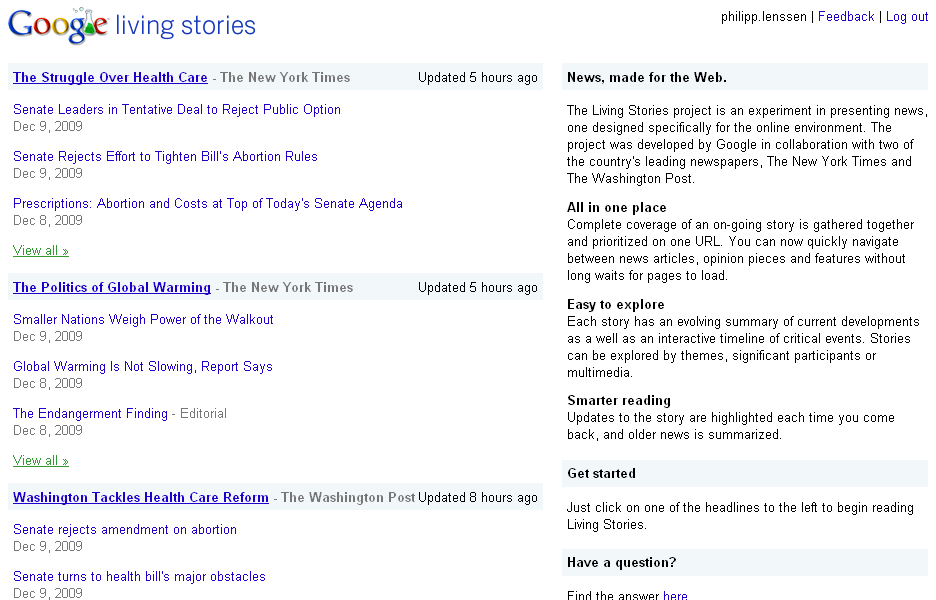
Google has partnered with the New York Times and the Washington Post news organizations to create an experimental type of news page they call "living story". In a blog post announcing this move, Google says that Living Stories try a non-traditional approach of presenting news: "They unify coverage on a single, dynamic page with a consistent URL. They organize information by developments in the story. They call your attention to changes in the story since you last viewed it so you can easily find the new material. Through a succinct summary of the whole story and regular updates, they offer a different online approach to balancing the overview with depth and context."

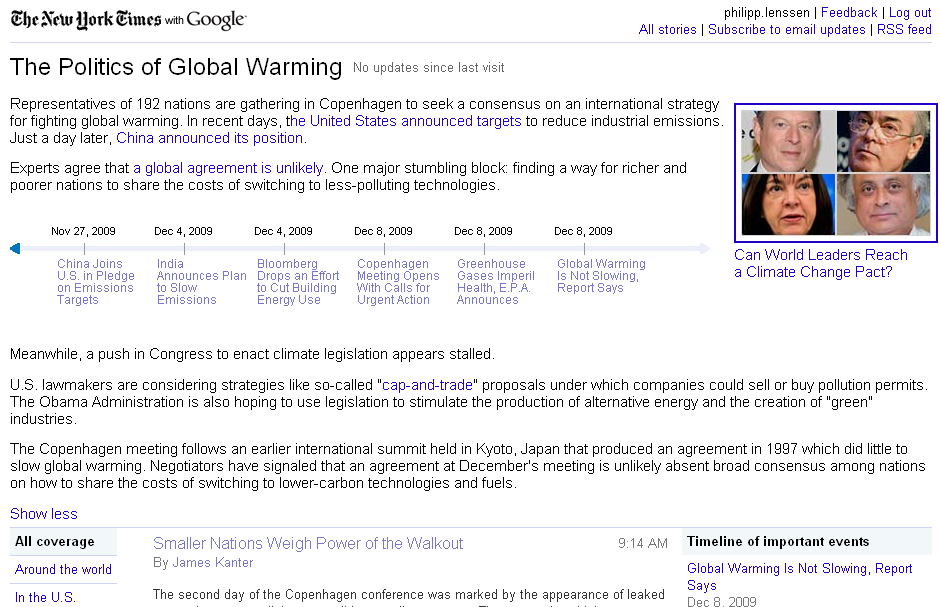
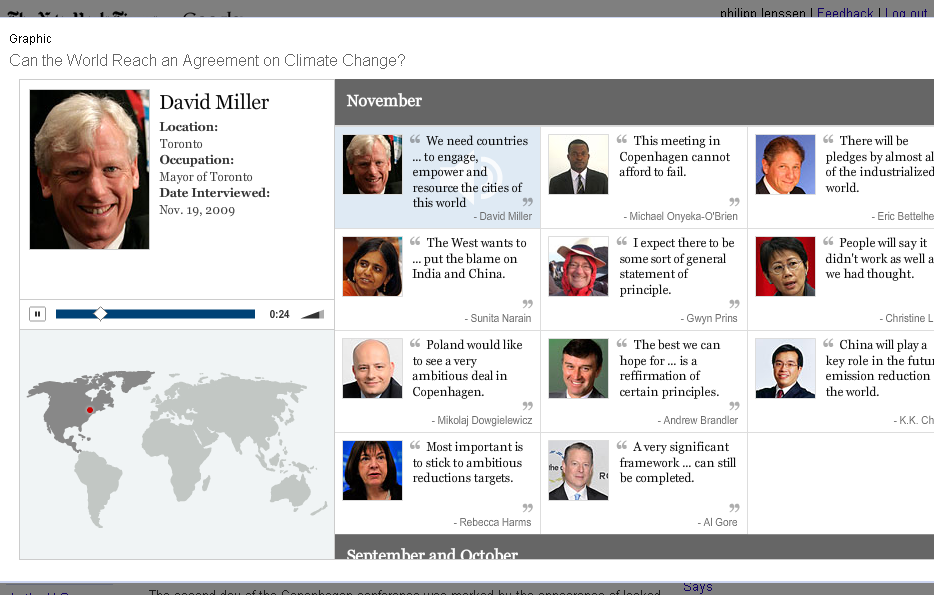
What does the article aggregation page feature? One page, for instance, is titled "The Politics of Global Warming". On it we can find interacting elements such as evolving textual summaries, timelines, audio content, image and video content. Areas can be expanded, while other areas scroll with you. You can sort in a variety of ways, like to restrict the news to quotes, or US news, or by showing the oldest news first. There are widgets like maps showing a person's location while streaming their audio quote. User comments are available too. Clicking on "Opinion" will list editorials only. Additionally, you can subscribe to email updates for a particular story set.

That's a lot of variety and room for interaction, though I can't yet tell if I wouldn't actually prefer a mostly-text-only overview of the same thing, presenting overviews, quotes, insights, images etc. in the order the journalist (or the editors of Wikipedia collectively presenting a topic) would deem most reasonable... to decide on that I'd have to give this a longer try. Are these many choices empowering, or confusing?

In regards to partnerships, which always creates interesting fields for conflicts of interests, the New York Times is probably the one news organization that Google grants closest insight access for reporting. For instance, Google once allowed a NYT reporter to spend a day with the search quality team, "observing some internal meetings and talking to several top engineers." The NYT has also employed search engine optimization techniques in the past which were often found to be borderline, even though we didn't see Google punish them for it (I won't conclude anything the NYT did was blackhat, because we often don't know what exactly the Googlebot saw at which point in time; we may want to assume innocent until proven guilty, but we also need to realize that the one most likely to have proof in these and future cases will always be Google Inc). Instead, Google has started to offer more official ways for news organizations to get their content indexed in Google while hiding it to a portion of users through a "First Click Free" policy. This is not to state that Google is already playing favors or will do so in the future, but when Google calls a particular source a "world-class" news organization in a blog post and partners with them in their tools, we at least have reason to take a closer look.

Now, in old Google News, the bias created by any particular news organization is somewhat balanced by presenting a huge variety of news organizations. Google's new experiment does not have this great source variety. Thus, the bias from the content producer is carried on by the tool maker. Here is a sample of NYT bias alleged by editors of Wikipedia – whether or not you agree with this particular bit, it goes to show that there's at least grounds for discussion when Google decides to go with a limited set of sources only:

In the build up to the 2003 war the New York Times published a number of stories claiming to prove that Iraq possessed WMD. One story in particular, written by Judith Miller helped persuade the American public that Iraq had WMD: in September 2002 she wrote about an intercepted shipment of aluminum tubes which the NYT said were to be used to develop nuclear material. It is now clear that they could not be used for that purpose. The story was followed up with television appearances by Colin Powell, Donald Rumsfeld and Condoleezza Rice all pointing to the story as part of the basis for taking military action against Iraq. Miller's sources were introduced to her by Ahmed Chalabi, an Iraqi exile favorable to a U.S. invasion of Iraq. Miller is also listed as a speaker for The Middle East Forum, an organization which openly declared support for an invasion.

From another angle, propaganda and power structures critic Noam Chomsky in an interview once stated:

[T]he elite media are sort of the agenda-setting media. That means The New York Times, The Washington Post, the major television channels, and so on. They set the general framework. Local media more or less adapt to their structure.

And they do this in all sorts of ways: by selection of topics, by distribution of concerns, by emphasis and framing of issues, by filtering of information, by bounding of debate within certain limits. They determine, they select, they shape, they control, they restrict – in order to serve the interests of dominant, elite groups in the society.

The New York Times is certainly the most important newspaper in the United States, and one could argue the most important newspaper in the world. The New York Times plays an enormous role in shaping the perception of the current world on the part of the politically active, educated classes. Also The New York Times has a special role, and I believe its editors probably feel that they bear a heavy burden, in the sense that The New York Times creates history.

That is, history is what appears in The New York Times archives; the place where people will go to find out what happened is The New York Times. Therefore it's extremely important if history is going to be shaped in an appropriate way, that certain things appear, certain things not appear, certain questions be asked, other questions be ignored, and that issues be framed in a particular fashion. Now in whose interests is history being so shaped? Well, I think that's not very difficult to answer.

And again, I don't think it's important whether we agree with this personal particular view... we just need to realize that these are the types of issues that come up when there's a limited source set. Google as a content-agnostic "mere toolmaker" needs to answer less questions on editorial guidelines – favoring one news source over another, however, is in itself an editorial decision. Thus we will need to ask new questions aimed at Google, too, like the following: How would a "living story" present the build up to another war?

[Thanks Mbegin!]

[By Philipp Lenssen | Origin: Google's "Living Stories" News Experiment | Comments]


[Advertisement] Books about Google available on Ebay


Things you can do from here:


Thursday, December 3, 2009

Twitter lists goodies without paying attention

If you are like me you sometimes want to keep up with whats going on but not right now. I subscribe to several Twitter lists but send the posts to my RSS reader so they are there when I can read them. I use Twitter List to RSS to create a feed out of a Twitter list. Just enter the Twitter list address in the box provided


If you need a list to follow, why not follow the library list of Twitter posts?
Use this address:
http://twitter.com/johntaube/alleganycountylibrary

Was Jane Austen killed by cows?

Was Jane Austen killed by cows?: "

jane austenWhat was the mysterious ailment that killed Jane Austen? Could she have been felled by the lovely cows in the English countryside? That's the theory of an article in the journal Medical Humanities.

Many have assumed that Austen died from Addison's disease, a once-fatal condition triggered by the failure of the renal glands. But in Medical Humanities, K.G. White examined the author's letters and found no mention of the painful symptoms common to Addison's. Her theory: Austen may have succumbed to tuberculosis contracted from cows. Here's a summary of her findings:

"Important symptoms reported by contemporary Addison’s patients—mental confusion, generalised pain and suffering, weight loss and anorexia—are absent from Jane Austen’s letters. Thus, by listening to the patient’s perspective, we can conclude it is unlikely that Addison’s disease caused Jane Austen’s demise. Disseminated bovine tuberculosis would offer a coherent explanation for her symptoms ... ."

A bit more on the topic from The Guardian.

Thanks to ReadStreet for the article tip.

"

Wednesday, December 2, 2009

More Research To Back The Notion That Streaming Kills Piracy

Thanks to TechCrunch for this post.

I was pleasantly surprised to read this what do you think?

More Research To Back The Notion That Streaming Kills Piracy: "

Research conducted by London-based Global Web Index, a collaboration between online market research agency Lightspeed Research and Trendstream, suggests that streaming might in fact be the right antidote against content piracy.


The findings are in line with other research and conclusions reached earlier this year by The Leading Question, MusicAlly’s consumer research division, which suggested that the number of teenagers who download copyrighted content from illegal sources has fallen dramatically over the past few years in favor of streaming.


According to the Global Web Index, streaming video online has unequivocally turned mainstream with almost two thirds (64%) of Internet users watching video clips, almost a third (31%) watching full length TV and video programming and 13% sharing videos. 27% of UK Internet users have downloaded free TV shows/films to their desktops.


The research showed that the most active internet users – those who spend more than three hours a day online – are the most likely to download illegal content, either through a P2P network or unauthorized file sharing websites.


Contrary to popular belief, the research also shows that people who download illegal media content are not only driven by the desire to access it for free, but increasingly by the fact that they want to get their hands on the content as soon as it’s available, even if only legally in other countries.


Whilst the research shows that consumers don’t really like using P2P networks to obtain content, people tend to use them when they can’t find what they want any other way.


Tom Smith, Managing Director of Trendstream says:


“Thanks to the rise of online services such as Spotify, Hulu, iPlayer and of course YouTube, the environment has been created where you can stream almost all the content you would ever want. If everything I want is available on demand, the concept of ownership is diminished. I no longer need to have it on my hard drive. I just play what I want when I want. This is not only a threat to traditional packaged sales of music, TV and film, it will also kill off piracy. Why pirate when you can stream?”


To reach its conclusions, Global Web Index interviewed 16,000 web users in 16 markets for a first wave. The survey was carried out online between July 6 and the August 7 of this year: 2000 internet users were interviewed in the US and the UK, 1000 users in France, Germany, Italy, Spain, China and Canada and 750 users took part in the survey in The Netherlands, Russia, Mexico, Brazil, India, South Korea , Australia, Japan. GWI plans a second wave this and next month.


(Top image via Flickr / cc Maurits Burger)


Crunch Network: CrunchBase the free database of technology companies, people, and investors


"